


Page 4 - Energy Recovery Ventilation
P. 4
Necessity of Ventilation


          The indoor air quality in South Korea is a growing concern due to high levels of bacterial
          contamination and the presence of heavy metal particles in fine dust. Furthermore, asbestos,
          a carcinogenic substance, has been detected at more than five times the recommended levels,
          indicating an urgent need to improve air quality through ventilation systems.


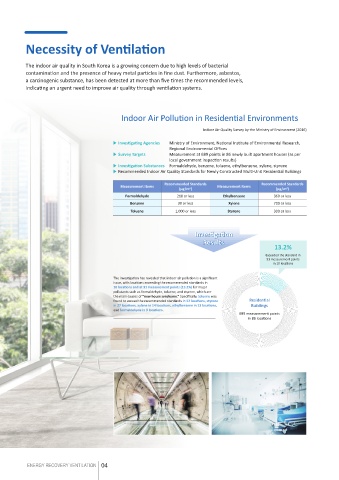
                                            Indoor Air Pollution in Residential Environments


                                                                        Indoor Air Quality Survey by the Ministry of Environment (2016)

                                         ▶ Investigating Agencies    Ministry of Environment, National Institute of Environmental Research,
                                                             Regional Environmental Offices
                                         ▶ Survey Targets      Measurement at 689 points in 86 newly built apartment houses (as per
                                                             local government inspection results)
                                         ▶ Investigation Substances  Formaldehyde, benzene, toluene, ethylbenzene, xylene, styrene
                                         ▶ Recommended Indoor Air Quality Standards for Newly Constructed Multi-Unit Residential Buildings

                                                           Recommended Standards             Recommended Standards
                                           Measurement Items                 Measurement Items
                                                                (µg/m3)                           (µg/m3)
                                             Formaldehyde      210 or less     Ethylbenzene      360 or less
                                               Benzene          30 or less       Xylene          700 or less
                                               Toluene         1,000 or less     Styrene         300 or less


                                                                     Investigation  vestigation
                                                                     In
                                                                        R
                                                                        Resultsesults
                                                                                                 13.2%
                                                                                              Exceeded the standard in
                                                                                               91 measurement points
                                                                                                 in 10 locations

                                         The investigation has revealed that indoor air pollution is a significant
                                         issue, with locations exceeding the recommended standards in
                                         10 locations and at 91 measurement points (13.2%) for major
                                         pollutants such as formaldehyde, toluene, and styrene, which are
                                         the main causes of “new house syndrome.” Specifically, toluene was
                                         found to exceed the recommended standards in 52 locations, styrene   Residential
                                         in 27 locations, xylene in 14 locations, ethylbenzene in 13 locations,   Buildings
                                         and formaldehyde in 9 locations.
                                                                                     689 measurement points
                                                                                        in 86 locations


           ENERGY RECOVERY VENTILATION  04

